Open Banking Is Here: What Connecting Your Bank Account Really Shares
n
nint
Privacy & Security·September 1, 2026
8 min read
Every time you tap "Connect your bank" in a finance app, you're making a decision most people never think twice about. In 2026, that decision matters more than ever.
Open banking has arrived in the United States. Under the CFPB's Section 1033 rule, banks are now required to hand over your transaction history, balances, and account details to any third party you authorize. On paper, it's about giving you control. In practice, understanding open banking privacy is the difference between sharing what you intend and quietly leaking a decade of your financial life.
Here's what actually happens when you connect an account, and how to stay in control.
What "Connecting Your Bank" Actually Does
When you link a bank account to a budgeting app, you're rarely handing over a single number. You're typically authorizing access to a rich stream of data:
- Up to 24 months of transaction history — every purchase, transfer, and payment
- Account balances across checking, savings, and credit
- Account and routing numbers
- Upcoming bill information and recurring charges
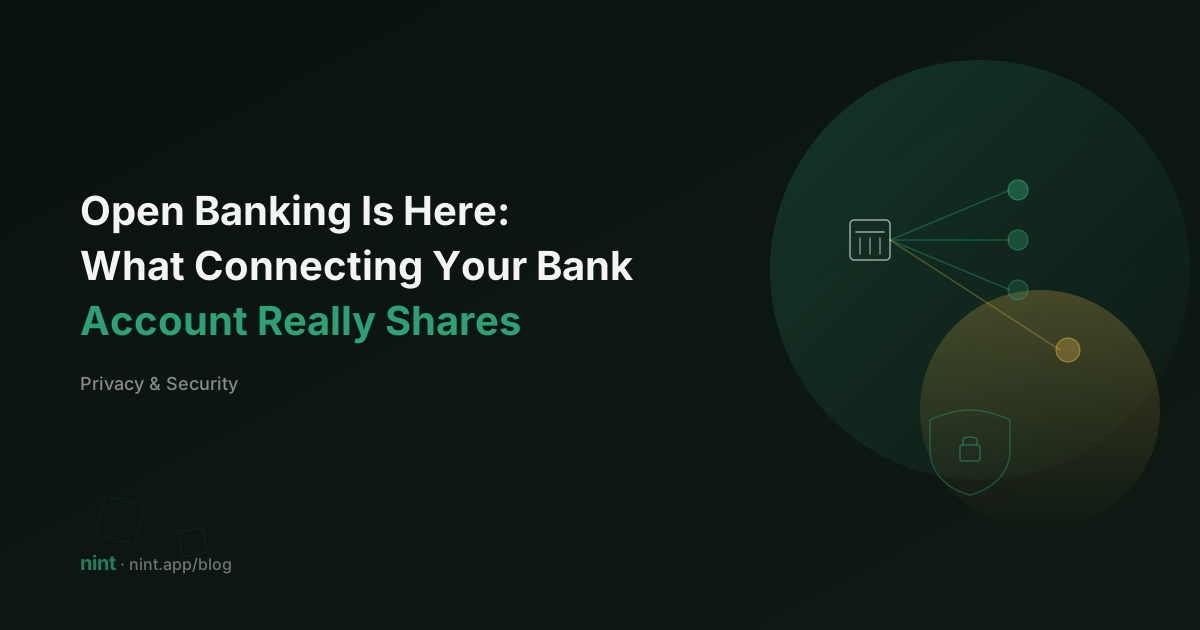
The CFPB's open banking rule explicitly covers all of this. And most apps don't connect to your bank directly — they route through a data aggregator (companies like Plaid, MX, or Finicity) that sits between the app and your bank. That means your data often passes through at least three parties before you see a single chart: your bank, the aggregator, and the app itself.
Each hop is another copy of your financial life sitting on another company's servers.
Open Banking Gives You Rights — But Not Automatic Privacy
It's easy to assume "regulated" means "safe." Open banking regulation is genuinely a win: it gives you the legal right to access and move your own data. But a right to share is not the same as protection after you share.
The rule governs how banks must make data available. It says far less about what the app on the other end does with it once you've clicked "authorize." That app can still:
- Store your transactions indefinitely
- Analyze your spending to build a marketing profile
- Share "anonymized" data with partners — even though a 2025 MIT study found just four transactions are enough to re-identify 90% of people in a supposedly anonymous dataset
The timing makes this sharper. As open banking expands consumer data sharing, oversight of data brokers has been rolling back — in 2025 U.S. regulators withdrew a proposal to supervise how brokers buy and sell personal information. More data flowing, fewer guardrails on where it ends up.
This is exactly why we built nint the way we did. nint doesn't route your accounts through a data-sharing pipeline you can't see — your financial data is processed locally, on your own device, and it stays there unless you explicitly choose to sync it between your own devices. Join 20,000+ people who track their finances without feeding an aggregator. It's the difference between a right you exercise and a risk you inherit.
The Aggregator Problem Nobody Talks About
Data aggregators are the invisible infrastructure of modern fintech. They're also a concentration of risk.
When one aggregator holds the banking credentials and transaction feeds for hundreds of apps and millions of users, it becomes an enormous target. A breach there doesn't leak one app's data — it can expose the financial lives connected through every app that relies on it. Between 2019 and 2026, financial platforms have collectively exposed billions of records, and aggregation layers have been squarely in the blast radius.
There's also a quieter cost: you lose visibility. Once your data enters an aggregator, you often can't tell which downstream partners received it, how long they keep it, or whether deleting the app actually deletes the data. According to Incogni's 2026 research, 60% of popular budgeting apps share user data with third parties, and 1 in 4 share your financial information specifically. Open banking makes that plumbing easier to build — not harder.
How to Stay Private in an Open Banking World
You don't have to opt out of modern finance to protect yourself. You just have to connect deliberately.
- Ask what happens after you authorize. A trustworthy app explains, in plain language, where your data goes and who touches it. Vague "trusted partners" language is a warning sign.
- Prefer manual or on-device options when they exist. Not every budgeting method needs a live bank connection. Apps that work from statements, receipts, or local imports keep the aggregator out of the loop entirely.
- Review and revoke connections regularly. Under open banking, you can see and cancel the third parties you've authorized. Treat it like a subscription audit — if you're not using a connection, kill it.
- Check the exit before you enter. Can you export everything in CSV or JSON? Is there real account deletion, not just "deactivation"? If leaving is hard, that tells you how the company thinks about ownership.
- Choose a business model that isn't your data. If you pay for the app, you're the customer. If it's free with no clear revenue, your transactions probably are the product.
The Bottom Line
Open banking is one of the most important shifts in personal finance in a decade. It hands you real control over your own data — but control only protects you if you use it deliberately. The rule opens the door; you decide who walks through it.
The safest data is the data that never leaves your device in the first place. Open banking privacy isn't about avoiding technology — it's about choosing tools that put you, not an aggregator, at the center. Ready to take control of your financial privacy? Try nint free at nint.app — your finances, your device, your rules.
Continue reading: 5 Red Flags Your Finance App Is Selling Your Data and How to Audit What Your Finance Apps Actually Know About You.
Share:
#Privacy & Security#Fintech
Ready to own your data?
Join 20,000+ users who have secured their financial future with nint's private vault technology.
Related Posts