nint
nint never tracks your financial data. Choose what else we may measure.
Essential
Security and session. Always on.
Usage analytics
Anonymous page usage via Google Analytics. Off by default.
nint
Privacy & Security·October 14, 2026
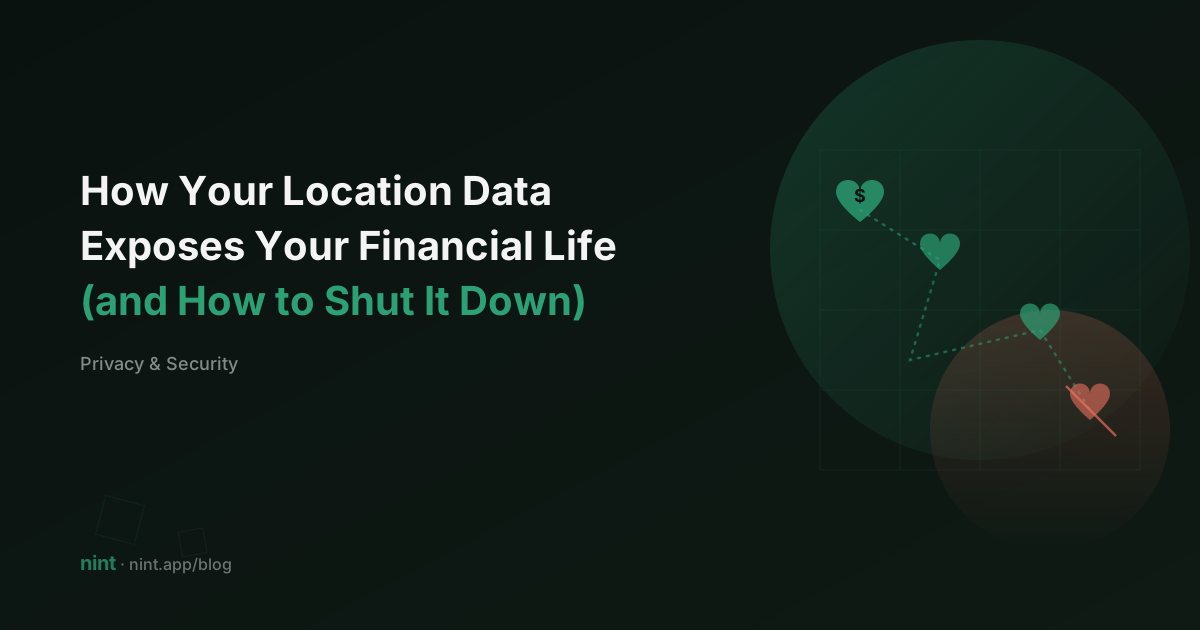
Here's an uncomfortable fact: the apps on your phone probably know your bank's branch, your payday grocery run, the pawn shop you visited once, and the clinic you'd rather nobody knew about. If you want to stop apps from selling your location data, you first have to understand that your movements are a financial profile — and in 2026, that profile is being sold at industrial scale.
The data broker industry is now worth roughly $316 billion in 2026, according to multiple market analyses. A slice of that is pure location: the Location-Data-as-a-Service market alone hit $2.82 billion in 2025 and is growing more than 20% a year. Your whereabouts aren't a byproduct anymore. They're the product.
Think about what your location history actually reveals about your money. The grocery store you choose signals your budget tier. A visit to a payday lender or a buy-here-pay-here car lot signals financial stress. Repeated trips to a wealth-management office signal the opposite. Where you live, where you work, and where you shop combine into a startlingly accurate estimate of your income, your debts, and your spending habits.
Advertisers and lenders pay for exactly this. Location data lets a company infer your financial situation without ever touching your bank account — no login, no permission, no open-banking connection required. It's a side door into your financial life that most people don't even know exists.
The quiet trade in location data stopped being quiet this year. In May 2026, the FTC banned data broker Kochava from selling sensitive location data after finding it had sold precise geolocation from hundreds of millions of mobile devices — data that could track individual visits to health clinics, places of worship, and domestic-violence shelters, all without consent.
It wasn't an isolated case. In January 2026, the FTC finalized an order against GM and OnStar for collecting drivers' precise geolocation and driving behavior through a misleading sign-up flow and selling it to third parties — including consumer reporting agencies that feed into credit and insurance decisions. The agency also reminded data brokers of their obligations under PADFAA, the law barring the sale of Americans' sensitive data to foreign adversaries.
The pattern is clear: regulators are treating location as sensitive financial data now. But enforcement is reactive and slow. The real protection is not letting the data escape in the first place.
This is exactly why we built nint the way we did. Your financial data — the spending patterns that would let anyone reconstruct where you go and what you can afford — stays on your device, analyzed locally, never shipped to a cloud that becomes one more pile of records waiting to be breached or sold. Join 20,000+ people who track their money without broadcasting their lives. The safest financial trail is the one you never leave.
You can cut off most of this in under 30 minutes. Work through all four steps — each closes a different leak.
1. Kill app location permissions you don't need. On iPhone, go to Settings → Privacy & Security → Location Services and set every non-essential app to "Never" or "Ask Next Time." On Android, Settings → Location → App permissions. A flashlight or budgeting app does not need your precise location in the background. Studies have repeatedly found the average phone carries dozens of apps requesting location, most for no functional reason.
2. Reset your advertising ID. Both iOS and Android assign your phone a unique advertising identifier that brokers use to stitch your location trail together. On iOS, turn off "Allow Apps to Request to Track" (Settings → Privacy & Security → Tracking). On Android, delete your Advertising ID entirely (Settings → Privacy → Ads).
3. Turn off background and precise location. For the apps that genuinely need location, give them "While Using" access and turn off "Precise Location" wherever a rough area is enough. This alone starves most broker pipelines of the exact coordinates they resell.
4. Opt out of the brokers directly. Submit opt-out requests to the biggest aggregators, and if you're in California, Texas, or another state with a data-broker registry, use the official registry to find and contact them. Under CCPA, GDPR, and newer state privacy laws, you have the right to demand deletion — and brokers are legally required to comply.
Here's where it gets specific to your money. Every finance app that lives in the cloud is a potential location-plus-spending correlation waiting to happen. When your transactions sit on a company's server and that company (or its ad SDKs) also collects location, the two can be joined: here's where you were, here's what you spent, here's the pattern.
A local-first app breaks that join. If your financial data never leaves your phone, there's no server-side copy to correlate against a location trail — no matter who gets breached. That's not a feature you toggle on. It's the architecture.
Your location data is a financial profile hiding in plain sight, and in 2026 it's being sold in a $316 billion market that regulators are only beginning to rein in. Spend 30 minutes shutting down location permissions, resetting your advertising ID, and opting out of brokers — it's one of the highest-leverage privacy moves you can make this year.
Then take the deeper step: stop handing your financial data to servers that can be joined with everything else about you. The most private money data is the data that never left your device.
Ready to take control of your financial privacy? Try nint free at nint.app — your finances, your device, your rules.
Continue reading: Data Brokers Are Selling Your Financial Life: How to Get It Back in 2026 and How to Delete Your Financial Data From Apps (And Actually Make It Stick) in 2026.
Join 20,000+ users who have secured their financial future with nint's private vault technology.
Related Posts