nint
nint never tracks your financial data. Choose what else we may measure.
Essential
Security and session. Always on.
Usage analytics
Anonymous page usage via Google Analytics. Off by default.
nint
Personal Finance·October 6, 2026
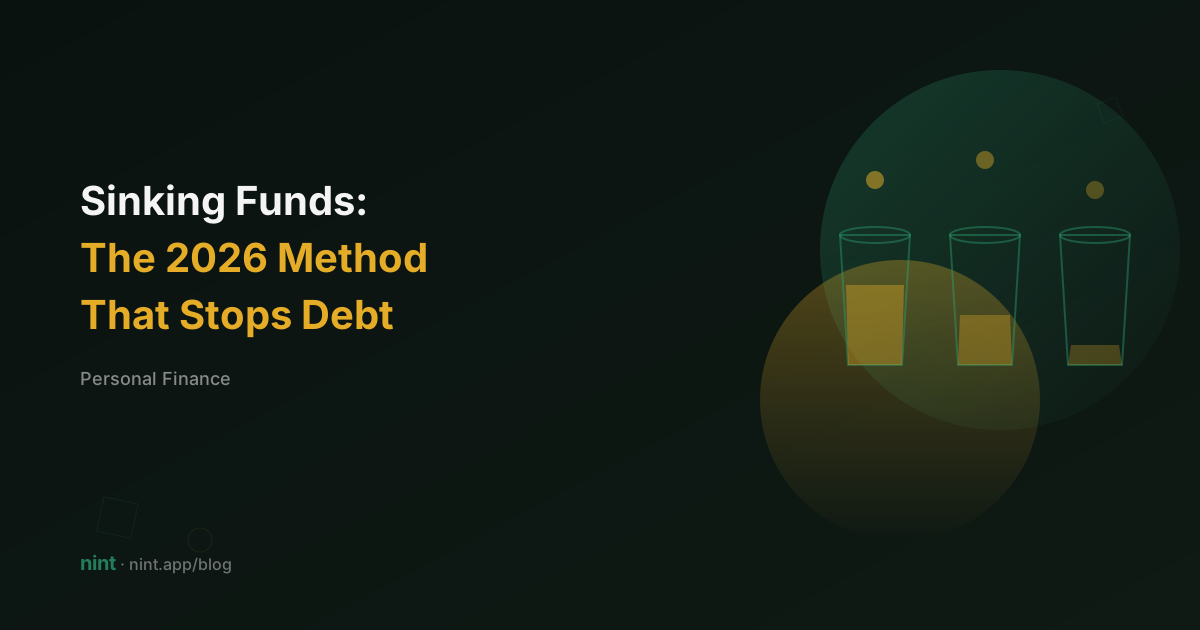
What if the next "surprise" expense that wrecks your month isn't actually a surprise? The $1,200 car insurance renewal, the $900 holiday spend, the $600 vet bill — none of them are unexpected. They're just unplanned. Sinking funds are the budgeting method that turns those predictable shocks into a quiet monthly rhythm, and in 2026 they're having a moment for good reason.
A sinking fund is a small pot of money you build up gradually for a specific expense you know is coming. When the bill lands, the cash is already there — no credit card, no raided emergency fund, no panic. Here's how to set one up, why it beats scrambling, and how to track your funds without handing your savings plans to a data broker.
People confuse the two, and it costs them. An emergency fund is for the unknown — a job loss, a medical crisis. A sinking fund is for the known-but-irregular — the things a calendar can predict.
When you don't separate them, every planned expense raids your emergency cushion. One survey found that 56% of Americans can't cover a $1,000 emergency from savings, yet most of those "emergencies" are recurring bills in disguise.
The fix is mental and mechanical: give every predictable large expense its own bucket, funded a little at a time. Your emergency fund stays sacred for true emergencies.
Here's the entire formula: total cost ÷ months until you need it = your monthly contribution.
That's it. No app, no spreadsheet gymnastics, no willpower. You're not "finding" money under pressure in December — you set aside a painless slice each month and let the calendar do the work.
The psychological win matters as much as the math. Research on mental accounting shows people are far more likely to leave money untouched when it's labeled for a purpose. A bucket named "Car Insurance" gets spent on car insurance. A blob of "savings" gets spent on whatever's loudest.
Start with the categories that blindside the most people:
You don't need all five at once. Pick the one that burned you most recently and start there.
This is exactly why we built Nint. Instead of juggling five separate accounts or a shoebox of envelopes, you create labeled funds and watch each one fill — with every number living on your device, not on a company's server. Join the growing community tracking their finances privately, without an algorithm learning that you're saving for a new roof.
You've probably seen "cash stuffing" on TikTok — physical envelopes stuffed with bills for each spending category. It's the same core idea as sinking funds, and part of its appeal is honest: cash leaves no digital trail. Many people reach for envelopes precisely because they're tired of every purchase being tracked, scored, and sold.
But physical cash has real downsides. It earns no interest, it can be lost or stolen, and it's clumsy for a $3,000 goal you're building over two years. In 2026, roughly 80% of transactions are already cashless, so an all-envelope system fights the way money actually moves.
The smarter move is to keep the privacy that draws people to cash while losing the friction. A digital sinking fund gives you the same labeled-bucket discipline — but it compounds in a savings account and takes you ten seconds to update. The only question is whether the tool tracking those buckets respects your privacy the way a stack of cash does.
The difference between a plan and a habit is whether it needs your attention. Automate these three things and your funds build themselves:
Auto-transfer on payday. Set a standing transfer for each fund the day your paycheck lands. Money you never see is money you don't spend.
Separate your buckets. Whether it's sub-accounts or labeled categories in an app, keep each fund visually distinct. Blending them back into one pile is how discipline dies.
Review quarterly, not daily. Check progress every three months. Watching a fund inch up day by day is discouraging; seeing a quarter of growth is motivating.
A quick data point worth internalizing: people who automate savings save roughly twice as much over time as those who transfer money manually, simply because automation removes the dozens of tiny "should I?" decisions.
Here's what most budgeting articles skip. The buckets you fund reveal more about your life than your bank statement does.
A "New Baby" fund signals a major life change — and a change in what you'll buy. A "House Down Payment" fund reveals your income bracket and timeline. A "Medical" fund hints at a health condition. Stitched together, your savings goals are a map of your future, and that map is worth real money to advertisers, insurers, and data brokers.
A local-first tool means those goals never leave your phone. No server knows you're saving for a wedding. No algorithm is adjusting the ads you see because you started a "Fertility Treatment" fund. Your plans are yours.
Budgeting should give you control over your money — not hand a profile of your intentions to someone else.
You don't need a perfect system. You need one bucket. Pick the expense most likely to blindside you in the next six months, do the simple division, and set up a single automatic transfer this week.
Thirty days from now you'll have proof that the next "surprise" bill isn't scary. A year from now you'll wonder how you ever did it the stressful way.
Ready to take control of your financial privacy? Try Nint free at nint.app and build sinking funds that stay on your device — never on someone else's server.
Continue reading:
Join 20,000+ users who have secured their financial future with nint's private vault technology.
Related Posts