nint
nintSarah Chen
Co-founder & CTO·June 20, 2026
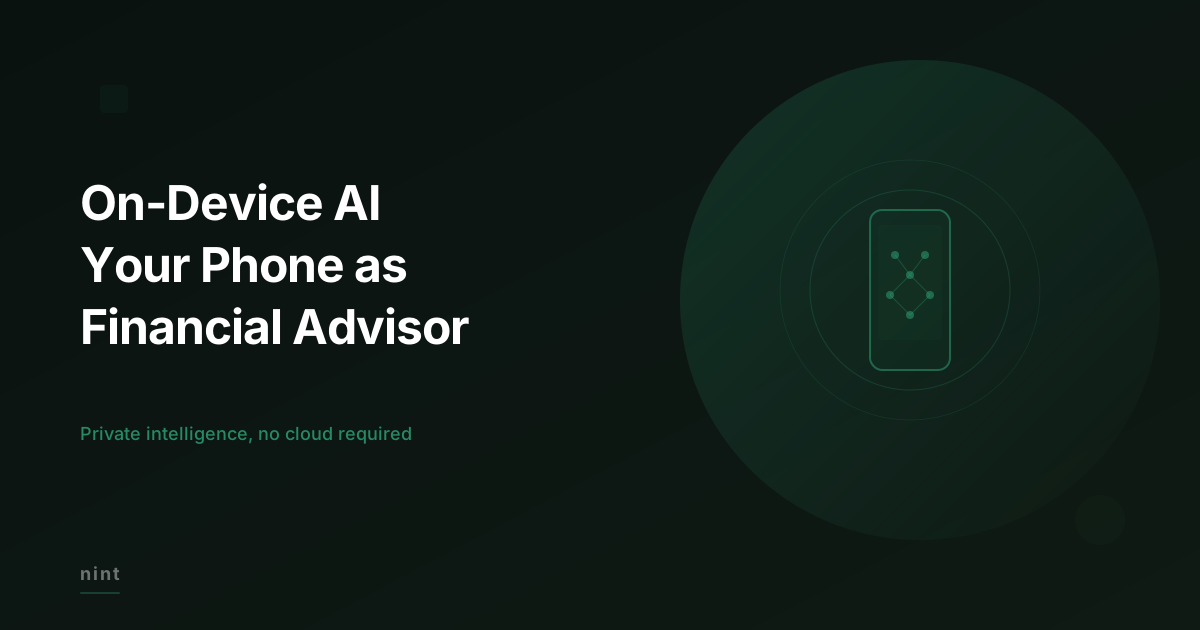
In 2026, on-device AI stopped being a future promise and became a practical reality. Your phone now has enough processing power to run sophisticated AI models locally, without sending any data to the cloud. Here's what that means for personal finance.
On-device AI means running machine learning models directly on your phone's processor instead of sending data to remote servers for processing. The model lives on your device. Your data never leaves.
Think of it this way:
Three developments converged to make on-device AI practical:
Modern phones include dedicated AI processors (Neural Processing Units). Apple's A-series, Qualcomm's Hexagon, and Google's Tensor chips can run models that required server farms just three years ago.
Researchers developed techniques (quantization, distillation, pruning) to shrink AI models from gigabytes to megabytes while retaining most of their capability. A model that needed 16GB of RAM in 2023 can now run in 500MB.
Both major platforms invested heavily in on-device AI infrastructure in 2024-2026, proving the concept works at scale and normalizing local processing for users.
AI classifies each transaction (groceries, dining, transportation) in milliseconds without sending transaction descriptions to any server. It learns your patterns over time, getting more accurate.
The model identifies trends: "You're spending 23% more on dining this month than your 3-month average." This happens instantly because all data and processing are local.
Based on your income, fixed expenses, and goals, AI suggests budget allocations that are realistic for your specific situation.
AI spots unusual charges (a new subscription you didn't authorize, a charge in an unusual location) and alerts you immediately.
Given your income pattern and spending trends, on-device AI projects future balances, helping you anticipate shortfalls before they happen.
Ask your finances questions in plain language: "How much did I spend on coffee this month?" or "Am I on track for my vacation fund?" The AI processes the query and your data entirely on your device.
Traditional financial AI works like this:
On-device AI works differently:
This matters because financial data is uniquely sensitive. Your transaction history reveals your health, relationships, habits, location patterns, income, and lifestyle in granular detail.
On-device AI isn't perfect:
These trade-offs are shrinking rapidly, and for personal finance use cases, on-device AI is already more than capable.
On-device AI makes it possible to have sophisticated financial guidance, the kind that used to require a human advisor or a cloud-based AI with full data access, while maintaining complete privacy.
Your phone already knows your financial life. On-device AI helps you make sense of it without sharing that intimate data with anyone.
nint's AI Money Coach runs entirely on your device. It categorizes transactions, identifies patterns, projects future spending, and provides personalized recommendations without any of your financial data leaving your phone.
It's like having a financial advisor who works 24/7, never judges, and literally cannot share your information with anyone because it physically cannot leave your device.
Get AI-powered financial advice without giving up your privacy. nint's on-device AI analyzes your spending, forecasts your budget, and provides personalized guidance, all without your data ever leaving your phone. The future of private finance is here.
Want to see how nint's AI financial coach works? Explore the AI Money Coach — a private, on-device financial advisor that runs entirely on your phone's neural engine.
Join 20,000+ users who have secured their financial future with nint's private vault technology.
Related Posts